


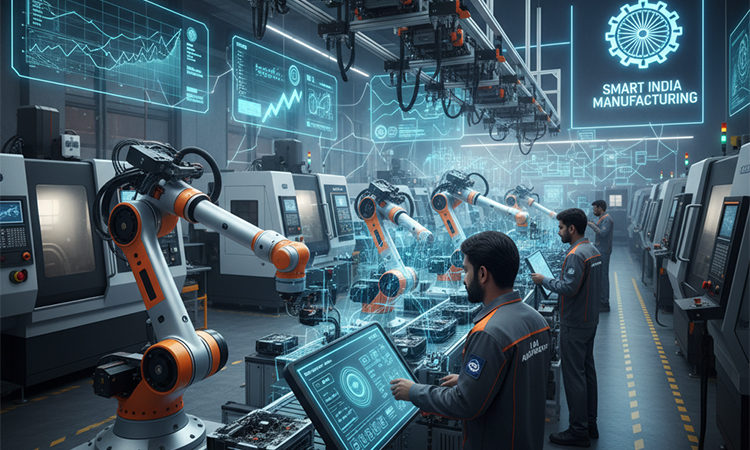
India’s manufacturing sector is undergoing a profound transformation, shifting its focus from labour-intensive scale to digitally orchestrated production. The integration of sensors, robots, Artificial Intelligence (AI), and connected shopfloor systems—the core components of a “Smart Factory”—is more than a technological update; it’s a fundamental redefinition of competitiveness, quality, and unit economics in the nation’s industrial landscape. This rewrite maps India’s current position against global benchmarks and outlines the strategic roadmap for realizing the potential of smart manufacturing.
The Global Automation Context
Globally, factory automation is no longer a niche concept but an irreversible, widespread trend. Manufacturers are aggressively pursuing automation to achieve consistency, lower unit costs, and faster speed-to-market. According to the International Federation of Robotics (IFR), global robot density—the number of operational industrial robots per 10,000 employees—has roughly doubled in recent years. Leading industrial nations now boast robot densities measured in the hundreds, demonstrating a clear worldwide pivot toward mechanized, data-driven production.
India’s Position: Fast Growth, Low Base
While India is an accelerating player in the automation space, it starts from a significantly lower installed base compared to global leaders.
- Rapid Installations: In 2023, India installed a record 8,510 industrial robots, marking a substantial year-on-year jump (approximately 59%). This brings the nation’s total operational stock to about 45,000 units. This steep growth trajectory reflects rising adoption in key sectors like automotive, rubber & plastics, electronics, and consumer goods.
- Market Momentum: Independent market projections place India’s industrial automation market value in the single-to-double-digit billion USD range currently, with high projected Compound Annual Growth Rates (CAGRs) throughout the decade. This growth is fuelled by factory modernization efforts, the falling cost of sensors, and accelerated software adoption.
- Density Lag: When comparing robot density, India lags significantly behind top nations. The rapid absolute installations are yet to translate into comparable density figures, which signals substantial room to scale automation across the broader, diverse manufacturing base.
Country-Wise Snapshot: The Competitiveness Link
Comparing robot density is crucial because it directly correlates automation with productivity, export competitiveness, and superior unit economics.
| Country/Region | Robot Density (Robots per 10,000 employees) | Context/Implication |
| South Korea & Singapore | Over 1,000 (South Korea); Very High (Singapore) | Global leaders; high density wins on precision and uptime, compensating for high labour costs. |
| China | Around 470 (2023) | Rapidly ascending; moved ahead of some traditional leaders, establishing itself as a high-volume, automated manufacturing hub. |
| Germany & Japan | Several Hundreds | Mature, highly automated automotive and electronics industries, setting high global benchmarks. |
| India | Behind Leaders | Signifies the challenge and opportunity to capture productivity and precision advantages through broad-scale automation. |
Countries with high robot density tend to compete less on labour cost advantages and more on precision, high uptime, and minimized per-unit labour content. These are the crucial competitive advantages India’s manufacturing sector is actively seeking to acquire for success in global markets.
The Three Structural Drivers for India’s Automation Push
The timing for India’s increased focus on smart factories is underpinned by three powerful structural drivers:
- Policy Tailwinds and Scale Ambition: India’s ambition to increase the manufacturing sector’s contribution (Manufacturing Value Added as % of GDP) signals the need to boost value-added per worker and move up the global supply chain. Government initiatives like the Production-Linked Incentive (PLI) schemes and state-level industrial policies are strategically channeling investments toward building modern, automated plants.
- Affordability of Technology: The democratization of technology is lowering the barrier to entry. The decreasing costs of sensors and compute power, combined with the availability of off-the-shelf components like PLCs, modular robot kits, and low-cost vision systems, make the initial investment feasible even for Small and Medium Enterprises (SMEs).
- Global Demand for Quality and Traceability: Global buyers are increasingly demanding traceability, consistent tolerances, and comprehensive digital audit trails. These non-negotiable standards are precisely what modern automation and smart-factory data stacks are designed to deliver, making them essential for Indian firms aspiring to become major exporters.
Overcoming Adoption Barriers
Despite the compelling drivers, the path to widespread smart-factory adoption faces significant headwinds:
- Fragmented SME Base: The majority of Indian factories are small, family-run entities. They often operate with thin capital budgets and lack the resources or spare capacity for complex, transformational digital projects.
- Skill Gaps: Automation requires a new breed of technicians skilled in mechatronics, network integration, and data analysis. Bridging this skills gap necessitates a major pivot in vocational training programs and educational curricula.
- Integration Complexity: Installing a new robot is often the easy part. The challenge lies in seamlessly integrating disparate legacy machines, Enterprise Resource Planning (ERP), Manufacturing Execution Systems (MES), and quality control systems into a single, cohesive “digital thread.”
- Capex vs. ROI Concerns: For manufacturers operating in lower-margin segments, the upfront capital expenditure (Capex) and the uncertainty surrounding the Return on Investment (ROI) often stall or prevent investment decisions.
Roadmap: Strategic Smart Factory Investment
To convert momentum into broad-based competitiveness, Indian manufacturers should adopt a pragmatic, phased roadmap focused on integration and people:
- Prioritize High-ROI Pilots: Instead of wholesale overhauls, factories should start by automating error-prone, repetitive operations (e.g., pick-and-place, inspection, deburring). This yields immediate, visible cost and quality wins, building internal confidence and capital for larger projects.
- Adopt MES-First Thinking: Before automating machine movement, manufacturers must automate machine data. Connecting machines to lightweight Manufacturing Execution Systems (MES) or data platforms reveals the true operational inefficiencies and bottlenecks, guiding more effective automation investment.
- Leverage Collaborative Robotics (Cobots): Collaborative robots (Cobots) are ideal for SMEs. They typically require less extensive safety infrastructure than traditional industrial robots and are designed to work alongside humans, making them easier and quicker to deploy.
- Upskill Strategically: Automation investments must be tied directly to workforce reskilling. Industry partnerships with vocational institutes are essential to train employees on the new demands of a hybrid human-machine shopfloor.
- Ecosystem Play: The entire ecosystem—OEMs, system integrators, financers, and government bodies—must collaborate to offer bundled Automation-as-a-Service options (leasing models, outcome-based contracts) to drastically lower the upfront financial barrier for SMEs.
What Success Looks Like
In the near future, successful Indian manufacturing plants will evolve into hybrid digital facilities. The shopfloor will feature:
- Humans focused on exception management, problem-solving, and creative tasks.
- Engineers tuning parameters and optimizing processes using virtual twins of the factory.
- Robots ensuring consistent precision and throughput.
- Cloud dashboards providing real-time data on Overall Equipment Effectiveness (OEE) and yield.
This shift will allow Indian firms to compete globally, not primarily on low labour cost, but on the superior value propositions of speed, quality, and predictable delivery. This is the game-changer required for success in export markets and premium domestic segments.
India has the momentum, the policy support, and the clear commercial drivers to succeed in the automation era. By focusing on pragmatic, data-driven pilots, robust systems integration, and investing strategically in its people, smart factories will not only make India’s manufacturing operations smarter—they will ensure the nation’s lasting relevance and competitiveness on the global industrial stage.