


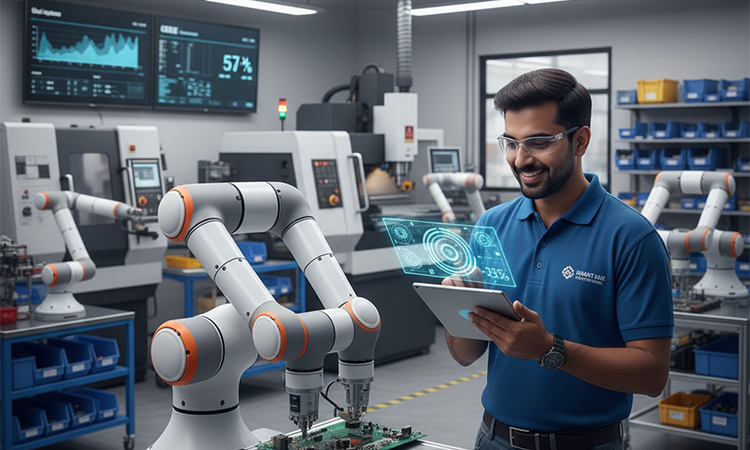
The Indian manufacturing landscape is rapidly evolving, driven by the need for increased competitiveness, superior productivity, and consistent quality. At the forefront of this shift, particularly for smaller players, is the adoption of Collaborative Robots, or ‘Cobots.’ While large enterprises have long automated their complex operations, cobots are now providing Small and Medium Enterprises (SMEs) with a flexible, affordable pathway to convert traditionally manual, repetitive tasks into efficient, modern production processes.
Accelerating Market Growth: The Cobot Opportunity
The Indian market for collaborative robots is currently in an explosive growth phase, underscoring its relevance as a realistic automation route for SMEs.
- Significant CAGR: Market estimates highlight this momentum. One analysis projected the Indian cobot market size at USD $115.3$ million in 2024, forecasting a surge to USD $2,306.3$ million by 2033. This translates to an exceptional Compound Annual Growth Rate (CAGR) of $36.6\%$ over the 2025-2033 period.
- Alternative Projections: A separate source reported the market at USD $148.82$ million in 2025, with projections reaching USD $689.08$ million by 2031, reflecting a strong CAGR of approximately $29.1\%$.
Regardless of the precise figure, these projections affirm that cobots are transitioning from a niche technology to a mainstream tool for digital transformation accessible to a widening base of manufacturing SMEs.
Why Cobots Attract SMEs: The Value Proposition
Cobots are fundamentally designed for safety, flexibility, and easy integration, making them uniquely suitable for the constraints and requirements of smaller-scale operations:
- Reduced Infrastructure Needs: Unlike large industrial robots, cobots are designed to work alongside humans without always requiring heavy safety fencing or major shopfloor reconfigurations, thus minimizing capital expenditure and downtime.
- Tangible Performance Gains: Local studies in India demonstrate significant benefits for SMEs deploying cobots, including:
o Uptime Improvements of $20\%$ to $25\%$.
o Error Reductions ranging from $30\%$ to $40\%$.
o Productivity Jumps of $15\%$ to $20\%$. - Ideal for Light Manufacturing: Due to their compact size and ease of redeployment, cobots with payloads up to 5 kg dominate the Indian market. These robots excel at the kind of light assembly, inspection, and packaging tasks that are typical in SME workflows.
- Rapid Return on Investment (ROI): Crucially for smaller firms, some reports suggest SMEs can achieve a full ROI within 6 to 12 months when cobots are deployed in optimal, high-impact use-cases.
High-Growth Application Sectors
Indian SMEs are increasingly integrating cobots across key industrial segments. High-growth sectors include:
- Automotive Components and Ancillaries: Automating repetitive fitting, inspection, and handling tasks.
- Electronics Sub-assembly: Handling delicate components with high precision.
- Rubber & Plastics: Pick-and-place and machine-tending operations.
- Metal Fabrication and Machining: Recent analysis notes the metals & machining segment as one of the fastest growing for collaborative robots, utilizing them for tasks like loading/unloading CNC machines or deburring.
Furthermore, supportive policies under the “Make in India” initiative, Production-Linked Incentives (PLI), and various state-led automation subsidies are playing a vital role in making cobot solutions more accessible and financially viable for SMEs.
Key Challenges to Widespread Adoption
Despite the promise, several obstacles are slowing down the broader rollout of cobots among SMEs:
- Integration Complexity: A significant hurdle is the non-trivial task of integrating new cobots with legacy machinery, existing workflows, and human operators. One study indicated that approximately $40\%$ of SMEs reported difficulties in retrofitting automation systems.
- Up-Front Cost Barriers: Though more affordable than traditional robots, the initial investment—including the cost of correct tooling, programming, specialized end-effectors, and safety configuration—still presents a financial challenge for capital-constrained SMEs.
- Workforce Readiness and Skills Gaps: SMEs require staff capable of configuring, maintaining, and swiftly redeploying cobots across different tasks. Insufficient technical skills and internal resistance to change management often slow the pace of progress.
- Mindset and Awareness: A prevailing mindset in some SMEs still associates automation exclusively with heavy, large-scale industrial operations. Cobots are actively working to shift this narrative by demonstrating practical, small-footprint solutions.
The Next Phase: A Strategic Roadmap for Success
For Indian SMEs to fully leverage the power of cobots and realize the projected market growth, they must adopt a strategic and human-centric approach:
- Target High-Impact Tasks: Select operations characterized by high frequency, ergonomic strain, or quality variability. Automating these areas yields the fastest, most compelling gains in quality and efficiency.
- Adopt Modular Deployment: Instead of attempting a costly, full-line transformation, SMEs should start with one or two cobots and then scale the deployment cell-by-cell based on proven success and ROI.
- Prioritize Training and Change Management: Success hinges on building a human-robot partnership. Upskilling operators and maintenance staff must be a central element of the investment, fostering acceptance rather than fear of replacement.
- Leverage Ecosystem Partnerships: Utilizing systems integrators, local service providers, and cobot Original Equipment Manufacturers (OEMs) is crucial. These partners can offer SME-specific, fast-deployment solutions with localized support and maintenance.
- Link to Broader Digital Systems: The cobot should be viewed as an entry point into a smarter factory. Connecting its machine data to production dashboards, enabling flexible re-programming, and integrating it with inventory systems will maximize its long-term value.
India’s vast SME manufacturing base is at a critical juncture. Collaborative robots offer a practical, affordable automation solution that enables these firms to boost output, reduce defects, and elevate product quality. With market CAGR showing strong promise and technology becoming more accessible, cobots are moving from a specialized tool to a new standard for SMEs aspiring to global competitiveness. However, future success will be determined by judicious task selection, a commitment to human-robot collaboration, and the integration of cobots into wider smart-manufacturing strategies.