


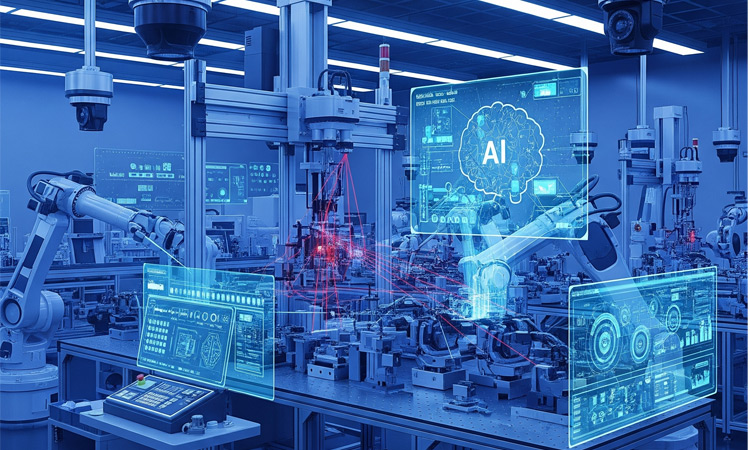
In 2025, machine vision has evolved far beyond its origins in basic visual inspection—it now stands as a foundational technology powering intelligent automation across manufacturing, logistics, pharmaceuticals, and more. With rapid advancements in AI, high-resolution optics, and edge computing, machine vision systems are transforming into highly capable “digital eyes” that not only see but understand and act. The global machine vision market, valued at USD 15.83 billion in 2025, is projected to reach USD 23.63 billion by 2030, growing at a CAGR of 8.3% (MarketsandMarkets), signaling its deepening role in Industry 4.0 ecosystems.
New Technologies & Innovations from Vendors
AI-Powered Vision Systems
Artificial intelligence, particularly deep learning, is redefining what’s possible in machine vision. Leading vendors such as Cognex, Basler AG, and Keyence are integrating AI directly into smart cameras and software, enabling capabilities like real-time defect detection, object classification, and adaptive quality inspection. For example, Keyence’s latest 2025 smart sensor with onboard AI can automatically detect part presence and verify orientation, even in complex, unstructured environments—without the need for programming expertise.
Rise of 3D Vision
3D machine vision is accelerating adoption in robotics and precision manufacturing. Providing spatial depth, these systems allow for accurate measurements, surface inspections, and robotic guidance. According to Market Research Future, the 3D vision market is projected to hit USD 3.59 billion by 2030. Vendors like SICK AG are delivering industrial-grade 3D systems with micrometer-level accuracy, ideal for applications in electronics, packaging, and automotive assembly.
Hyperspectral & Multispectral Imaging
Advanced imaging that captures data beyond the visible spectrum is opening up new frontiers, particularly in agriculture, food processing, and pharmaceuticals. Hyperspectral systems detect chemical composition, contamination, or spoilage in products that traditional cameras would miss. These technologies ensure compliance, reduce waste, and enhance safety in highly regulated sectors.
Edge & Embedded Vision
Edge computing is now a staple in modern vision systems. Cameras equipped with embedded processors analyze data on-device, reducing latency and bandwidth consumption. This is critical for fast-moving production lines and autonomous equipment. Embedded vision is seeing strong uptake in compact, cost-sensitive applications like mobile robots, medical devices, and packaging lines.
Flexible Software Platforms
Software-defined vision platforms now allow users to customize and simulate vision applications quickly. Combining classic vision tools with AI, these platforms offer greater adaptability, remote management, and real-time analytics—enabling smarter, more integrated workflows across factory floors.
Impact Across Industries
- Manufacturing: Machine vision ensures product quality, enables robotic assembly, and improves yield. It’s central to smart factories, with over 90% of manufacturers prioritizing vision systems as part of their digital transformation.
- Automotive: From surface inspection to ADAS (Advanced Driver-Assistance Systems), vision technology enables safety, precision, and full automation in both production and end-use.
- Pharmaceuticals & Life Sciences: Used in drug packaging inspection, dose verification, and lab automation, machine vision supports compliance and accuracy. AI-powered vision is also playing a growing role in research and diagnostics.
- Food & Beverage: Ensures contamination-free processing, consistent quality, and efficient sorting, with hyperspectral vision enabling next-level safety and inspection.
- E-commerce & Logistics: Machine vision automates barcode reading, sorting, and parcel dimensioning, streamlining high-volume warehouse operations.
Looking Ahead
As machine vision continues to merge with AI, robotics, and IIoT, it’s poised to become an even more critical enabler of smart industry. Challenges like integration complexity and cost are being mitigated by plug-and-play platforms and modular solutions. With capabilities expanding and accessibility improving, machine vision is no longer a luxury—it’s a necessity for competitive, data-driven industrial operations.