


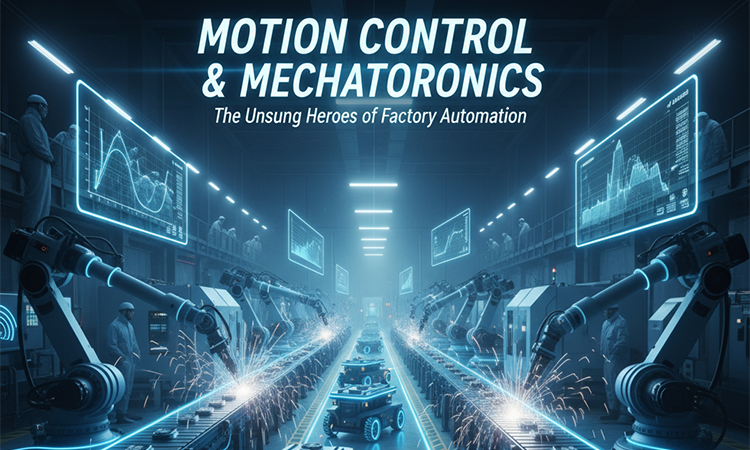
In the gleaming landscape of modern smart factories, concepts like AI, robotics, and IIoT often capture the headlines. Yet, behind every precise robotic movement, every high-speed conveyor, and every accurately positioned component, lie the unsung heroes: motion control systems and mechatronics. These foundational technologies are the brains and brawn that translate digital commands into physical action, ensuring the speed, precision, and reliability critical for today’s automated manufacturing.
The Precision Core of Automation
Motion control is the technology that governs the movement of machines, providing precise control over position, velocity, and acceleration. This involves a complex interplay of controllers, drives, motors, and feedback devices (like encoders). Mechatronics takes this a step further, integrating mechanical engineering, electronics, computer control, and systems design to create intelligent machines and systems that move and operate with remarkable dexterity. Think of a robotic arm picking a delicate component or a CNC machine carving intricate details – that’s motion control and mechatronics in action.
Industry Stats: A Market Driven by Precision
The global market for motion control and mechatronics is robust and expanding, reflecting their indispensable role in industrial automation:
- Significant Market Size: The global motion control market was valued at approximately USD 17.5 billion in 2023 and is projected to reach USD 25.5 billion by 2028, growing at a CAGR of 7.8% during the forecast period. (MarketsandMarkets)
- Mechatronics Dominance: While specific mechatronics market figures are often embedded within broader automation reports, the global mechatronics and robotics market is expected to grow significantly, with one report estimating it to reach USD 245.5 billion by 2029 at a CAGR of 11.4%. This underscores the integrated nature of these technologies. (Fortune Business Insights)
- Key Drivers: The surge in demand for factory automation, the increasing adoption of industrial robots, and the push for higher precision and energy efficiency across industries are primary growth drivers.
The Pillars of Modern Manufacturing
Motion control and mechatronics are vital across almost every facet of automated production:
- Robotics: They are the fundamental building blocks of every industrial robot, enabling multi-axis movement with sub-millimeter accuracy for tasks ranging from welding and assembly to pick-and-place operations.
- CNC Machining: The precision of CNC lathes, mills, and grinders relies entirely on sophisticated motion control to guide cutting tools along complex paths, ensuring tight tolerances and high-quality finishes.
- Material Handling & Logistics: Automated guided vehicles (AGVs), conveyor systems, and automated storage and retrieval systems (AS/RS) depend on synchronized motion to move products efficiently through warehouses and production lines.
- Packaging & Printing: High-speed packaging machines require precise motion to cut, fold, seal, and label, while modern printing presses achieve impeccable registration thanks to advanced motion control.
- Assembly Automation: From automotive lines to electronics manufacturing, complex assembly processes rely on coordinated movements of multiple components and tools.
Driving Innovation and Efficiency
Beyond mere functionality, advancements in motion control and mechatronics are directly enabling new levels of innovation and efficiency:
- Enhanced Precision and Speed: Newer servo drives and motors, combined with advanced control algorithms, allow for faster cycle times and even greater accuracy, crucial for micro-manufacturing and complex assembly.
- Energy Efficiency: Intelligent motion systems can optimize motor usage and regeneration, leading to significant energy savings—a growing concern for manufacturers globally.
- Flexibility and Adaptability: Integrated mechatronic systems are becoming easier to reprogram and reconfigure, allowing factories to quickly adapt to changing product designs and production demands. This is especially vital for the high-mix, low-volume production characteristic of Industry 4.0.
- Integration with AI/IIoT: As motion components become “smarter” with embedded sensors and connectivity, they feed valuable data into AI and IIoT platforms, enabling predictive maintenance, real-time process optimization, and digital twin capabilities.
While often operating quietly behind the scenes, motion control and mechatronics are the indispensable engines of modern factory automation. Their continuous evolution in precision, speed, and intelligence underpins the capabilities of every smart factory, transforming digital strategies into tangible, physical outcomes. As industries push for higher levels of automation and efficiency, these unsung heroes will remain at the very heart of manufacturing innovation.