


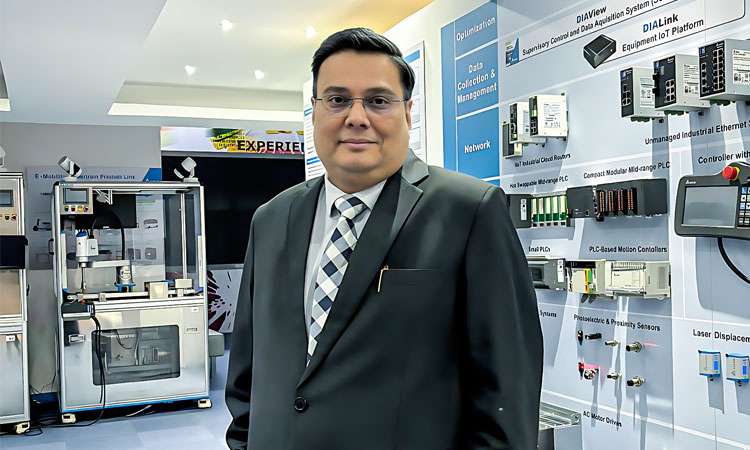
From pioneering industrial automation to redefining EV Solutions, Delta Electronics is at heart of India’s shift toward Industry 5.0. With collaborative robots, sustainable manufacturing systems, and AI-driven decision-making tools, Delta Industrial Automation Business Group, under the leadership of Dr. Sanjeev Srivastava, is setting the benchmark for human-centric, intelligent, and sustainable manufacturing future. Here’s how this global powerhouse is rewriting the rules of industrial transformation in 2025 and beyond
Delta Electronics: Shaping a Collaborative, Sustainable Future

As the global industrial landscape moves beyond automation toward collaboration, Delta Electronics isn’t just keeping pace—it’s leading the change. Industry 5.0, which emphasizes the synergy of human intelligence with advanced automation, is rapidly gaining momentum. And Delta, with its deep roots in innovation and sustainability, is driving this next wave of transformation in India.
Dr. Sanjeev Srivastava, Head of the Industrial Automation Business Group at Delta Electronics India, outlines a clear and compelling vision. “Industry 4.0 gave us connectivity, automation, and data,” he explains. “But Industry 5.0 is about collaboration, empathy, and resilience. It’s about leveraging machines to empower human capabilities—not replace them.”
Delta’s presence in India is bolstered by manufacturing hubs in Gurgaon, Uttarakhand, and Krishnagiri, Tamil Nadu, along with a robust R&D center in Bengaluru that houses over 500 engineers. “More than 70% of our Indian R&D team comprises postgraduates or PhDs,” notes Dr. Srivastava. “This is a knowledge-driven transformation.”
From Automation to Collaboration: The Rise of the Cobot
Delta’s transition from traditional automation to collaborative systems is best illustrated through its development of cobots—collaborative robots designed to work side-by-side with humans. Unlike traditional industrial robots that require safety enclosures, cobots are equipped with smart sensors and adaptive intelligence, enabling safe and intuitive human-machine interaction.
“The Delta D-Bot cobots, launched at ELECRAMA 2025, are capable of payloads up to 30 kg and can operate at high speeds,” says Dr. Srivastava. “They’re revolutionizing sectors like electronics manufacturing, packaging, welding, and materials handling.” These cobots are not merely machines—they are digital teammates, designed to support rather than replace.
Complementing these are ergonomic workstations, AR-based training modules, and a renewed focus on worker safety and comfort. “Whether it’s a production floor or a maintenance bay, comfort and safety directly influence productivity,” Dr. Srivastava adds.
Beyond Machines: The Delta Sustainability Blueprint
What sets Delta apart is its unwavering focus on sustainability. The company embeds carbon neutrality and circular economy principles into its operations. For example, energy recovery systems developed by Delta reduce consumption by up to 40%. Intelligent power conditioning modules prioritize renewable energy sources. And across its global infrastructure—including 35 offices and two data centers—green building certifications are standard.
“Since 2006, our systems have helped save over 43 billion kilowatt-hours of electricity, equivalent to cutting 43,000 tonnes of CO₂ emissions,” notes Dr. Srivastava. “Sustainability is not a buzzword for us—it’s a design principle.”
Delta also encourages customers to return end-of-life systems for recycling, promoting circular manufacturing models that align with India’s growing environmental consciousness.
Real-World Innovation: Impact at Every Level
One example of Delta’s practical innovation is its digital transformation of the promotional token system in the paint industry. A seemingly minor task—placing promotional tokens in paint buckets—was historically prone to human error. Delta introduced an automated insertion and tracking system that not only ensured every bucket contained a single token, but also enabled geographic sales analysis via integrated barcodes.
“This simple upgrade improved accuracy, reduced waste, and delivered valuable sales insights,” Dr. Srivastava explains. “That’s the power of contextual automation.”
Expanding Capabilities and Markets
Delta’s roadmap is as ambitious as it is clear. “Over the next five years, we aim to double our business in India by entering underserved markets and expanding our OEM partnerships,” Dr. Srivastava shares. This includes deepening its presence in machine tools, automotive, electronics, and semiconductor industries—sectors poised for exponential automation growth.
To support this expansion, Delta plans to scale its team across regions, strengthen service capabilities, and invest further in R&D. “Our Bangalore HQ will be the nerve center for automation engineering and software development,” he says.
India at the Center of Industry 5.0
India’s industrial sector is undergoing rapid transformation, and Delta Electronics is poised to be a catalyst. “India’s automation market is expanding exponentially,” says Dr. Srivastava. “With our advanced solutions and integrated approach—combining hardware, communication networks, and analytics—we are empowering Indian manufacturers to embrace Industry 5.0 confidently.”
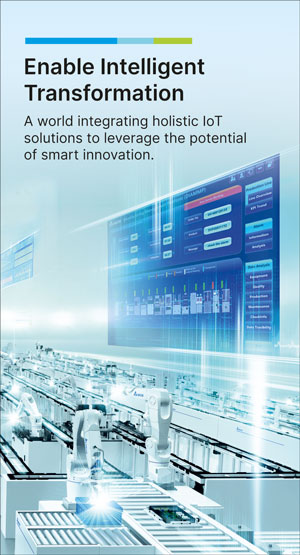
From real-time data insights to seamless connectivity between the shop floor and the boardroom, Delta’s end-to-end automation portfolio is redefining efficiency and decision-making at every level.
Technology with a Human Heart
Delta’s journey into Industry 5.0 is more than a technological shift—it’s a philosophical one. It’s about restoring the human element to the heart of the factory, supported—not replaced—by machines.
As Dr. Srivastava aptly summarizes, “The next industrial revolution is not about man versus machine. It’s about man with machine. And Delta is here to make that future possible—intelligent, collaborative, and sustainable.”